If a Data Center Comes to Town, Your Electric Bill Should Go Down
Data centers should pay their grid costs through bankable large-load tariffs and fund a separate, project-sized dividend for the households that host them.
Pete Ghiorse
Group Product Manager, AI/ML · Founder, Honeydew
If a data center comes to town, your electric bill should go down.
In March 2026, Amazon, Google, Meta, Microsoft, OpenAI, Oracle, and xAI signed the White House’s voluntary Ratepayer Protection Pledge. They agreed to obtain new power, pay for delivery infrastructure, and keep paying if their demand falls short.
That should be the minimum. If a company wants to place an enormous industrial load beside a town, it should also give residents a visible share of the value created by hosting it.
I first proposed cutting every affected household’s actual bill by 25 percent. That makes clean copy and a bad contract. At the 2024 national average, the promise costs $4.27 million a year for 10,000 meters—and $42.68 million for 100,000. The same project would face a tenfold liability because it crossed an arbitrary municipal line. The percentage also pays high-use households more and weakens the price signal to conserve electricity.
So tie the obligation to the project, not the household bill.
Two separate deals
Data centers turn electricity, equipment, and skilled work into computation that Americans increasingly use. That is a reason to build some of them here, not an entitlement to land, water, grid capacity, or a permit.
A host community is granting two different things. The first is utility service. The project should pay the cost it causes through a large-load tariff: studies, new generation and network upgrades, minimum demand charges, and termination costs if promised demand never arrives. The Department of Energy identifies cost shifting, resource adequacy, and stranded infrastructure as the central large-load rate-design risks.
The second is permission to build in a particular place. The project consumes scarce interconnection capacity and imposes local noise, water demand, construction, and opportunity cost. A separate sponsor-funded dividend pays for that host value. Cost recovery keeps other ratepayers whole; the dividend pays the host community. Treating them as one payment makes both harder to audit.
Cost causation alone does not justify a dividend. The second payment prices land-use approval, environmental capacity, and local consent. The sponsor may pass it to cloud customers, accept a lower return, or choose another site. Host assets are not free, and paying one’s utility costs is not a public benefit. In return, the sponsor gets something valuable: a defined path through permitting and energization, with obligations fixed before capital is committed.
The economic case is real but easy to oversell. Virginia’s legislative auditor estimated that the industry supports $9.1 billion in annual state GDP and 74,000 jobs, mostly through construction. A typical 250,000-square-foot facility may have only about 50 full-time workers. Across five mature data-center markets, data-center tax revenue ranged from less than 1 percent to 31 percent of total local revenue. Those numbers argue for a project-specific fiscal analysis after abatements and public costs, not a generic jobs multiplier. (Virginia JLARC)
Scale is not permission
Golf is only one familiar benchmark. Communities already live beside warehouses, transmission lines, factories, and irrigated land. Each has costs that can be measured. A server campus looks scarier partly because it is new.
The median American 18-hole golf facility applies 83.9 acre-feet of irrigation water a year: 27.3 million gallons. (GCSAA report, Table 39)
There is no meaningful “average data center,” so I use a declared scenario: 100 megawatts maximum at the utility meter, 50 megawatts on average, and power usage effectiveness of 1.40. The 50-megawatt average is an assumption, not an industry average. Applying Berkeley Lab’s modeled 2023 hyperscale median of 0.32 liters per IT kilowatt-hour and its higher 0.40-liter sensitivity produces roughly 26 to 33 million gallons a year onsite. At full meter draw, it becomes 53 to 66 million—roughly two to two-and-a-half golf facilities. (LBNL report)
Those measures are not equivalent. Golf reports water applied; Berkeley Lab reports water consumed onsite and excludes water used to generate electricity. The comparison establishes an order of magnitude, not hydrological equivalence or permission to build. The real questions are local: this watershed, this source, this meter, and this drought plan.
Power must arrive before the load
Annual energy matching is not reliability. A solar farm can generate as many megawatt-hours as a data center uses in a year and still provide nothing when the servers run at two in the morning.
New supply must be incremental, deliverable to the relevant grid, and sufficient—along with accredited capacity, reserves, transmission, and backup service—to cover the project’s coincident peak. Energization should occur in phases as those milestones are met. Flexible load deserves a credit only after it proves that grid operators can dispatch it. FERC’s 2026 large-load proceeding makes the underlying point: these rules are still evolving, and one national template will not fit every grid.
The tariff should allocate costs before construction through deposits, upgrade contributions, minimum billing, take-or-pay terms, collateral, and an exit charge. Annual true-ups can reconcile measured variances; they cannot rescue a vague promise to calculate the grid “with and without” the project forever. Virginia’s new large-load class already requires at least 14 years of service, minimum payments for 85 percent of contracted transmission and distribution demand, and collateral covering up to 60 percent of minimum charges. (Virginia State Corporation Commission)
A dividend a company can finance
The annual pool should equal a negotiated sponsor charge per contracted kilowatt-year. That fixes the obligation before financial close and prevents a lightly used facility from starving the promise.
In the 100-megawatt example, a charge of about $42.68 per contracted kilowatt-year funds about $4.27 million. At 50 percent average use, that works out to $9.74 per megawatt-hour—just under one cent per facility kilowatt-hour. Across 10,000 eligible homes, the pool provides an equal $426.78 annual credit, equivalent to 25 percent of the 2024 average U.S. residential bill. Across 100,000 homes, it provides about $42.68, not 25 percent. That is the tradeoff the old formula concealed. The national bill is only a scale reference; an actual agreement would use a standard local bill fixed at financial close. (EIA residential bill data)
The 25 percent outcome is political: a line in the sand, not the answer to an equation. It is large enough for residents to notice and the sponsor to price. Neither side gets to pretend the bargain is free. The negotiated charge should reflect project scale, competing sites, local constraints, and approval value. Before the permit vote, publish contracted capacity, eligible residences, term, and dollars per residence.
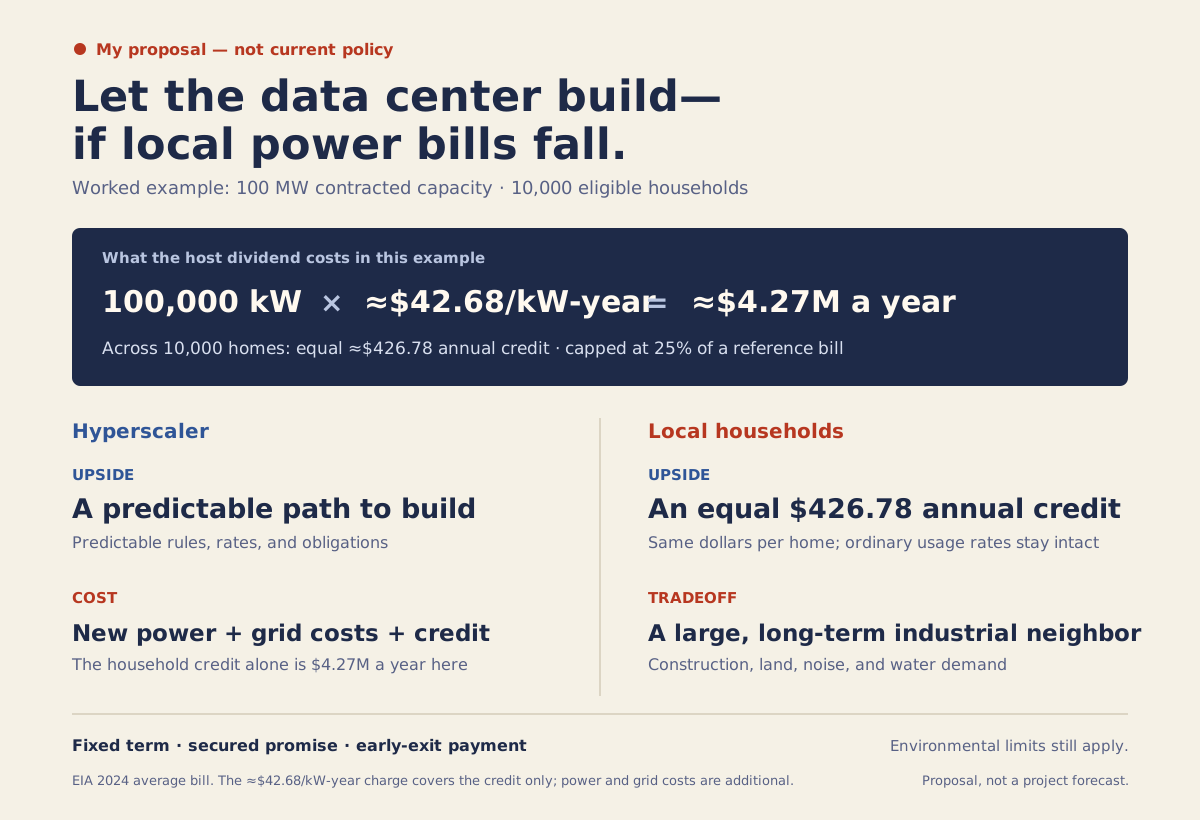
Each occupied residence receives the same dollar credit, capped at 25 percent of a standard reference bill. Ordinary per-kilowatt-hour prices remain unchanged, so a large house does not collect more than an apartment and conservation still pays. Renters count. A master-metered building needs an audited tenant pass-through or direct payments.
An independent local-impact study should define eligibility, not a town line or sponsor-drawn boundary. Grid effects may span a utility region while water, noise, and land-use effects remain local. The tariff handles regional electrical costs; the dividend goes to occupied residences in the host-impact zone fixed before financial close. Annexation or later bargaining cannot expand it.
The eligible premises, sponsor charge, contracted capacity, inflation index, and term are fixed before financial close. Capacity expansions reopen the formula; annexation does not. The named operating customer, property owner, and anchor tenant provide the liability stack, backed by collateral, a defined parent guarantee, an exit payment, and successor obligations if the site changes hands.
This cannot be improvised by one mayor. The utility commission approves the large-load tariff. A development agreement or community trust holds the dividend obligation. The utility may administer the bill credit only where law authorizes it and the sponsor has prefunded it. Where that authority does not exist, the legislature must create it.
What money cannot buy
The dividend comes after non-negotiable health and environmental limits, not instead of them. A water-intensive cooling system may not belong above a stressed aquifer. A gas-turbine complex may fail an air-quality limit regardless of the credit. Noise, habitat, emergency planning, and land use remain separate tests.
The agreement also needs a public ledger: monthly peak power; water withdrawn, consumed, discharged, potable, and reclaimed; construction and permanent jobs promised versus filled; subsidies, taxes, sponsor payments, and credits. Publish the underlying numbers, not a sustainability score.
Jobs deserve their own correction. Construction hours, permanent onsite positions, and modeled spillovers are different claims. Report wages, local hires, apprenticeships, and filled positions separately, with the original promise still visible five years later.
Build the data centers. Make them pay their grid costs, then put the host community’s share on the bill.
—Pete
Share this article
Continue the thread
Related reading
Essay
Monsters of the Mind
We taught a generation to mistake disruption to the jobs they wanted for the disappearance of work itself. The map is changing—and the technology redrawing it may also help us learn the next route.
Read next
Essay
Falls the Shadow
In 2016 the godfather of AI said to stop training radiologists. A decade later their pay had climbed and employers reported shortages. This essay asks whether the same forecast error is now being made about writing—through the two halves of every job, the vagueness spiral, and a falsifiable bet on the English major.
Read next
Essay
In What Furnace
AI keeps getting sold as a way to remove friction. There are two kinds, and only one is worth removing. An essay on toil, the work that builds you, and aiming your impatience at the right thing.
Read next