Monsters of the Mind
We taught a generation to mistake disruption to the jobs they wanted for the disappearance of work itself. The map is changing—and the technology redrawing it may also help us learn the next route.
Pete Ghiorse
Group Product Manager, AI/ML · Founder, Honeydew
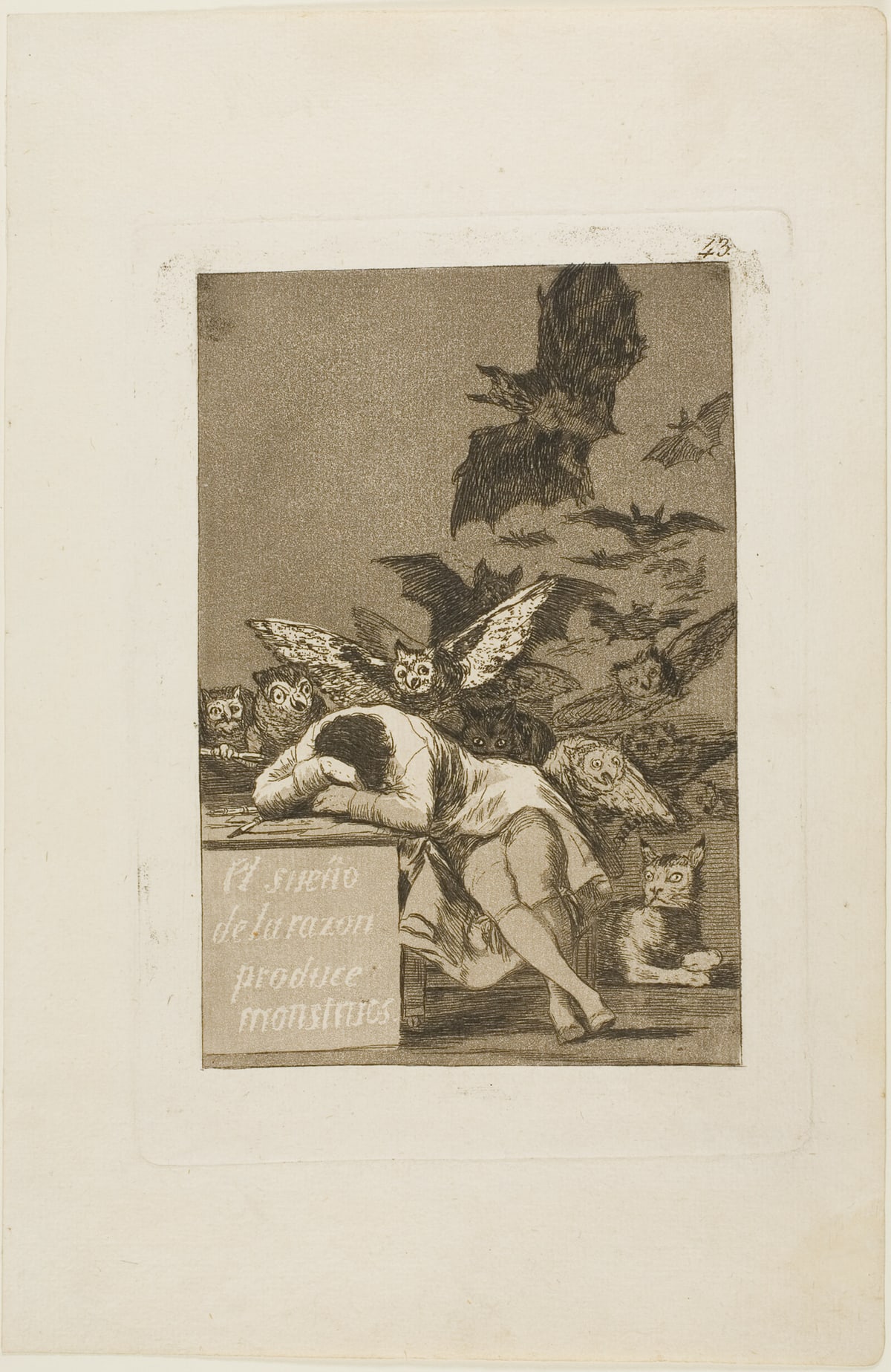
Francisco Goya, The Sleep of Reason Produces Monsters, 1797–99. CC0, Art Institute of Chicago.
The forecast young people are inheriting now is simple: artificial intelligence is coming for the work, and by the time they arrive there may be none left worth doing.
I think we have confused two different events. AI is disrupting the jobs we taught young people to want. That is not the same thing as work disappearing. It is the collapse of a status map: the old route from college to credential to laptop to security, treated for so long as the only respectable direction a life could travel.
The map is changing. The strange fact we keep leaving out is that the technology redrawing it may also be a powerful tool for learning the next route.
We already have one completed AI jobs forecast. In 2016, Geoffrey Hinton said we should stop training radiologists; a decade later, pay had climbed and the American College of Radiology described a shortage. I wrote about the outcome in Falls the Shadow. Hinton now says what he misjudged was the economics, not the technology’s capacity to read scans. Notice the shape of the correction: a claim that could empty a decade of medical students’ plans gets amended years later, at no cost to the person who made it. The cost was paid by whoever believed him at twenty-two.
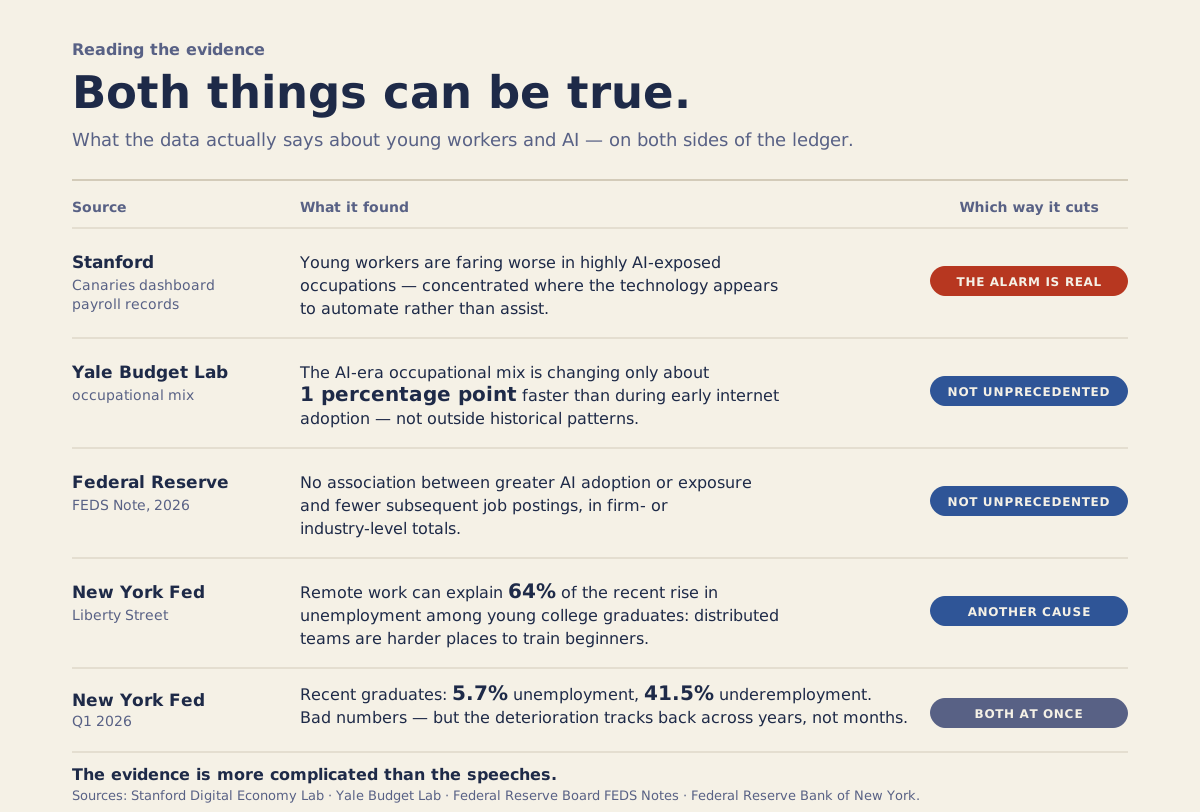
That does not mean today’s twenty-two-year-olds are imagining the problem. Stanford’s Canaries dashboard, built from millions of payroll records, finds young workers doing worse in highly AI-exposed occupations, especially where the technology appears to automate rather than assist. The sample is not the whole economy, and exposure is not causation, but the signal is serious enough to carry.
Other data makes the picture less apocalyptic. Yale’s Budget Lab finds the AI-era occupational mix changing only about one percentage point faster than during early internet adoption—not outside historical patterns. A Federal Reserve note found no association between greater AI adoption or exposure and fewer subsequent job postings in firm- or industry-level totals. In the first quarter of 2026, recent college graduates faced 5.7 percent unemployment and 41.5 percent underemployment. Bad numbers. But the New York Fed tracks the deterioration back across years, not months.
Both things can be true: a concentrated effect in exposed entry-level work inside a broader slowdown with more than one cause. New York Fed researchers estimate that remote work can explain 64 percent of the recent rise in unemployment among young college graduates, partly because distributed teams are harder places to train beginners. The timing predates generative AI. The evidence is more complicated than the speeches. The speeches are still winning.
A forecast can become a planning assumption. In the worst version, the assumption becomes a hiring freeze and the freeze is offered as proof of the forecast. Call it AI-washing when a company attributes a workforce decision to AI without measuring what AI changed. The technology may still matter; the forecast does not prove the decision was inevitable.
The doomerism of the young is not a failure to listen to us. It is evidence that they did.
When we say there will be no jobs, we rarely mean no work at all. We mean there may be fewer of the jobs our culture taught ambitious young people to recognize as success.
For forty years we built one ladder and called it the economy. Do well in school. Go to college. Acquire the vocabulary of a profession. Move information around on a screen. The ladder worked for enough people that it became moral advice. A good job slowly came to mean an office job, then a knowledge job, then a job you could do from a laptop without ever touching the thing your work changed.
AI arrived first for that category. It can draft the memo, summarize the contract, write the routine code, build the deck, and assemble the analysis. The work most exposed to generative AI happens to be the work we spent a generation assigning the most status. So we interpreted a threat to the top of our ladder as the removal of the ground.
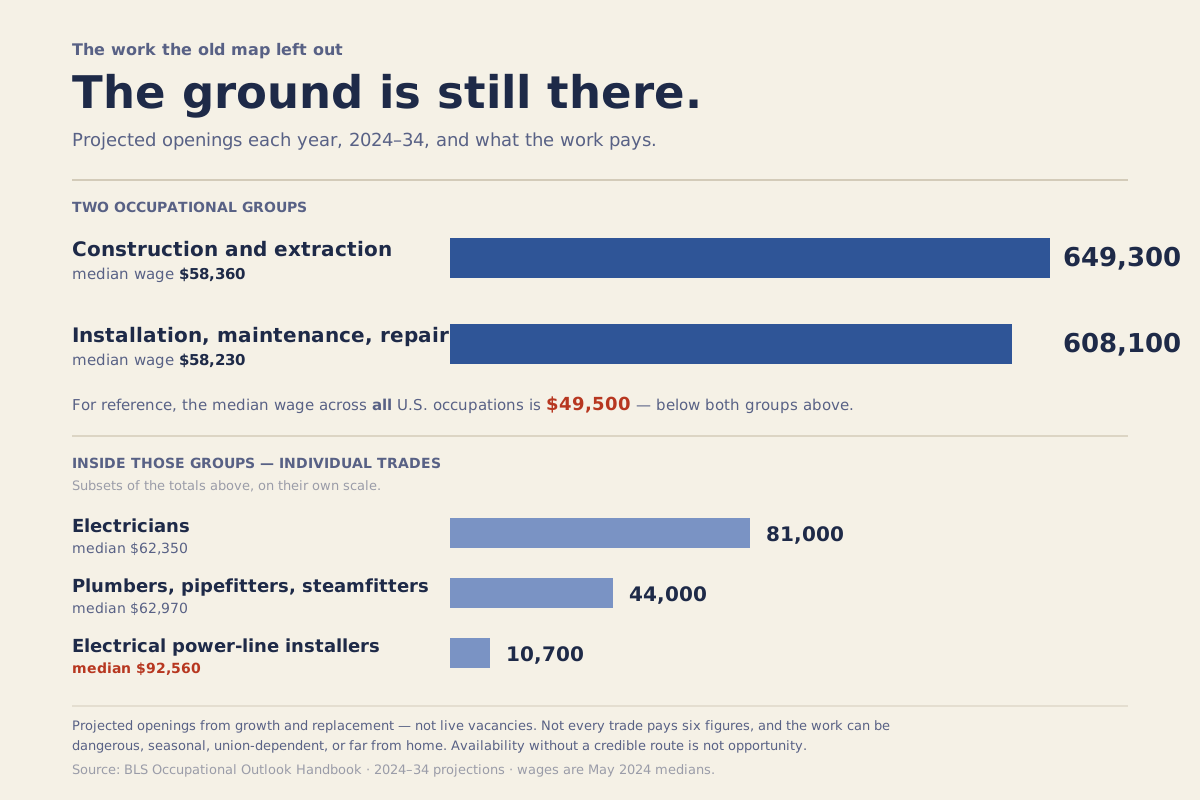
The ground is still there.
The Bureau of Labor Statistics projects about 649,300 openings a year in construction and extraction through 2034. The median wage for the group is $58,360, above the $49,500 median across all occupations. Installation, maintenance, and repair adds another 608,100 projected openings a year at a similar median wage. Electricians: 81,000 openings a year. Plumbers and pipefitters: 44,000. Electrical lineworkers: 10,700, at a median wage above $92,000.
Those are projected openings from growth and replacement, not live vacancies. Not every trade pays six figures, and the work can be dangerous, seasonal, union-dependent, or far from home. It may require licensing, tools, childcare, or years in an apprenticeship before the attractive wage arrives. Availability without a credible route is not opportunity.
And “go become a plumber” is not an answer to every frightened graduate. Some bodies cannot do physical work. Some people have gifts that belong in laboratories, classrooms, studios, hospitals, and offices. White-collar work still matters. The answer to one status hierarchy is not to build its inverse.
The point is smaller and more radical: we do not have a shortage of socially necessary work. We have a status system that tells young people which work counts.
That definition is already being repriced. Generic cognitive execution is getting cheaper; situated work remains stubbornly specific. A model can write a paragraph about a failed compressor from anywhere. Somebody still has to stand beside it, notice what the paragraph missed, make the repair, and own what happens when the system turns back on. In Falls the Shadow, I called this two jobs wearing one coat. Here the scarce half is presence, judgment, and accountability.
There is a lesson in the occupations we kept calling fallbacks. The trades have a name for paying someone while they are not yet excellent: an apprenticeship. White-collar work used to call a parallel arrangement an entry-level job. The trades still say the quiet part plainly: a beginner is there to learn while working.
Entry-level work is not mostly purchased output. It is a transfer of judgment: a novice makes bounded mistakes, an expert corrects them, and over time the correction becomes instinct. When a company cuts the bottom rung because a model can produce the junior employee’s first draft, it does not eliminate the cost of training a professional. It moves that cost onto the one person in the chain with no savings, no leverage, and no way to bill for it.
An AI tutor cannot repair that alone. A young person cannot apprentice to a chatbot. There has to be real work, an experienced practitioner, a standard that matters, and a place where mistakes are corrected before they become dangerous.
The loom could not explain itself to the weaver. The tractor could not help the farmhand identify a new field, translate the manual, rehearse the interview, or study for a certification at two in the morning. This machine can sit on the worker’s side of the transition.
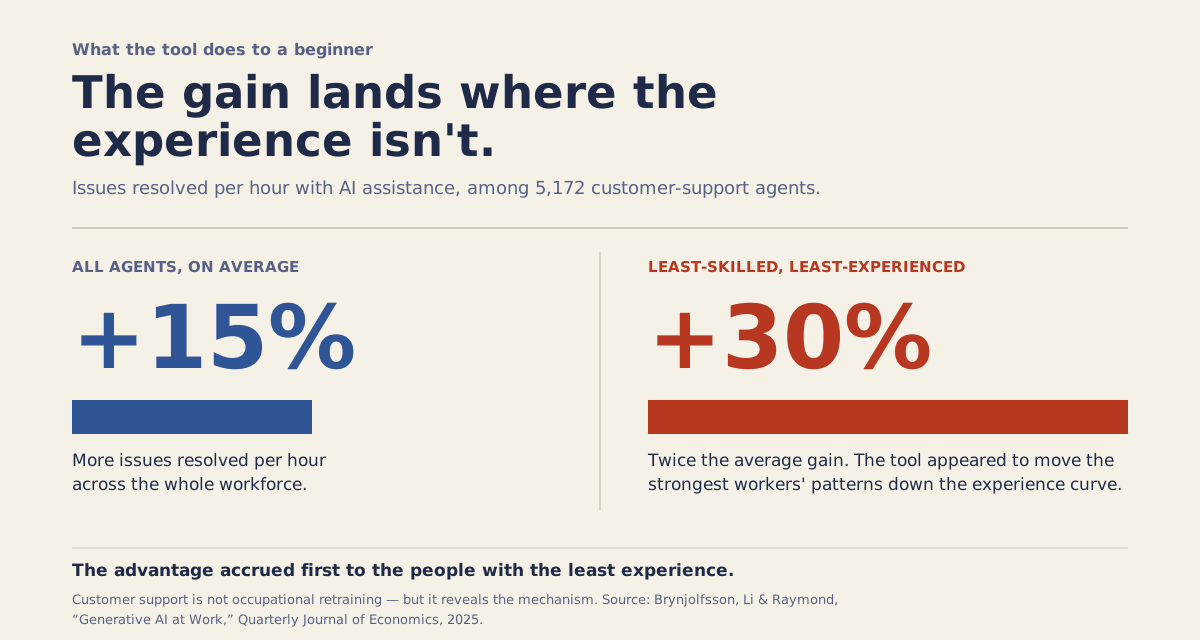
Customer support is not occupational retraining, but one study reveals the mechanism. Among 5,172 support agents, AI assistance increased issues resolved per hour by 15 percent on average and by 30 percent among less-skilled and less-experienced workers. The tool appeared to move patterns used by the strongest workers down the experience curve. The advantage accrued first to the people with the least experience.
Structured AI tutors are beginning to show the same possibility. In a randomized crossover trial covering two lessons in one Harvard physics course, a carefully designed tutor produced more than twice the median short-term learning gain of the active-learning classroom condition. The qualifications are the whole point: carefully designed, grounded in expert material, built to teach rather than answer.
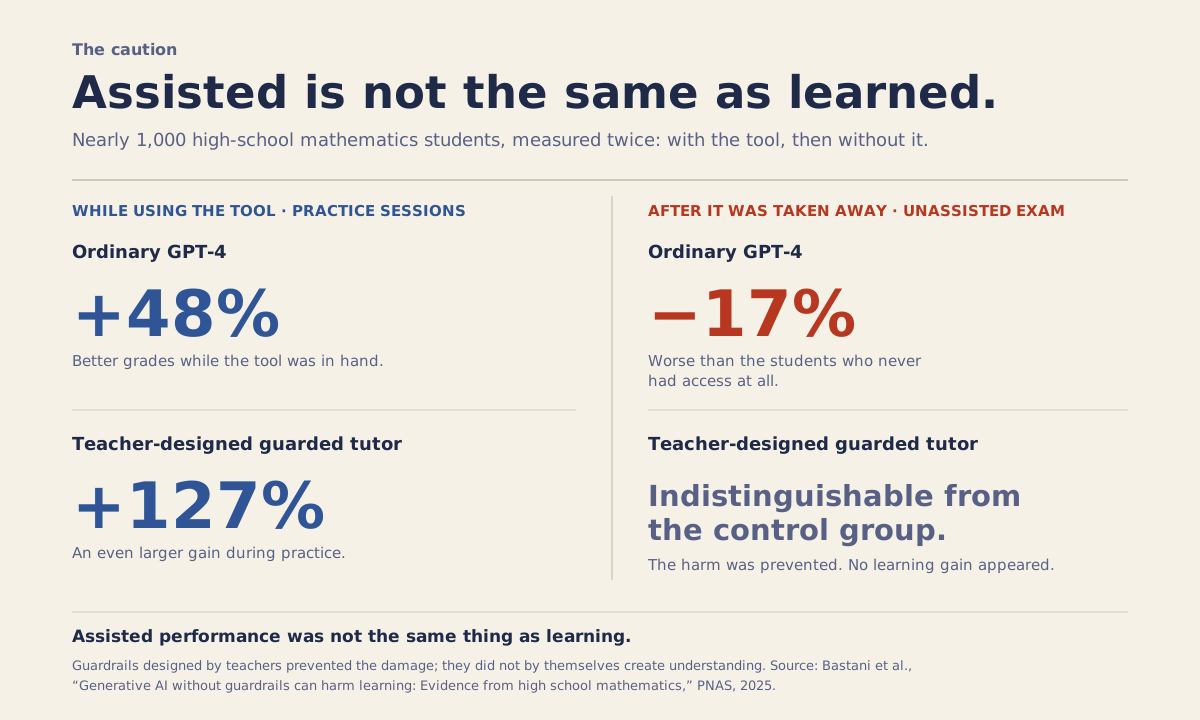
An unrestricted model can do the opposite. In a high-school mathematics experiment, students given ordinary GPT-4 performed better while they had it and worse when it was taken away. A guarded tutor designed by teachers largely mitigated that damage. Assisted performance was not the same thing as learning.
An adaptation system must separate three things. Assisted capability is what a worker can do with the tool. Internalized competence is what they understand without it. Professional judgment is knowing when the tool is wrong, when the situation is unsafe, and when the problem belongs to someone more qualified. It also carries accountability: somebody still has to answer for the outcome. AI can help with the first two. Only supervised practice confers the third.
A tutor should explain, quiz, demonstrate, and require an attempt. It can decode a certification syllabus, prepare someone for an exam, then later help with quotes, invoices, and schedules—the administrative shell around a practical skill. It cannot supply a license, a wage while learning, supervised hands, childcare, transportation, healthcare, or somebody willing to hire a beginner. The technology can be part of the adaptation engine. It cannot be the whole engine.
The old contract front-loaded learning: get educated early, acquire an occupational identity, and expect it to remain legible for forty years. Its replacement cannot promise everyone the particular job they were taught to want. It can promise a credible way to learn useful work again.
Pair the digital teacher with a human path into paid work. Put practitioner-built tutors in institutions that already serve beginners, connect them to paid apprenticeships, and fund the supports that make training possible. Learning a new livelihood takes time, and rent remains due while it happens. A Department of Labor evaluation found that registered apprenticeship participants had higher employment and earnings than comparison groups. AI should strengthen that route, not replace it with a prompt box and an instruction to hustle.
The call is addressed to us: hire juniors because someone still has to become senior. Preserve paid places to learn. Put the forecast’s error bars where the microphone is, not in the follow-up interview three years later. Say the true reason for a layoff even when the fashionable one flatters the stock. Stop using uncertainty as permission to close the door before anyone arrives—and stop talking about the old status map as though it were the economy itself.
Goya’s caption had two clauses, and we mostly remember the first. Fantasy abandoned by reason produces impossible monsters. United with reason, she becomes the mother of the arts.
The young do not need another promise that everything will be fine. It will not be fine for everyone, and previous transitions were never painless for the people living through them. They need something more useful: an honest map of where work is, dignity for the work the old map excluded, and a public path to the strange new tool that can help them learn the route—not merely a private edge.
The disruption is real. So are the monsters we made by mistaking one status map for the whole economy. But the map is still being drawn.
—Pete
Share this article
Continue the thread
Related reading
Essay
If a Data Center Comes to Town, Your Electric Bill Should Go Down
Data centers should pay their grid costs through bankable large-load tariffs and fund a separate, project-sized dividend for the households that host them.
Read next
Essay
Falls the Shadow
In 2016 the godfather of AI said to stop training radiologists. A decade later their pay had climbed and employers reported shortages. This essay asks whether the same forecast error is now being made about writing—through the two halves of every job, the vagueness spiral, and a falsifiable bet on the English major.
Read next
Essay
In What Furnace
AI keeps getting sold as a way to remove friction. There are two kinds, and only one is worth removing. An essay on toil, the work that builds you, and aiming your impatience at the right thing.
Read next