In What Furnace
AI keeps getting sold as a way to remove friction. There are two kinds, and only one is worth removing. An essay on toil, the work that builds you, and aiming your impatience at the right thing.
Pete Ghiorse
Group Product Manager, AI/ML · Founder, Honeydew
The case against AI usually gets written off as fear of the unknown. It isn’t. The fear is specific, and we earned it.
For a few years the pitch has been a list of jobs the machine can do instead of you. It passed the bar. It wrote the essay. It shipped the app, read the scan, made the call. Every headline has the same subject, and the subject is never the person reading it. Tell people long enough that a tool exists to replace them, and you shouldn’t be surprised when they hate the tool.
It isn’t only arrogance. “It replaced a lawyer” is a claim you can measure. “It made a lawyer better at the part of the work that’s actually hers” is not. So we make the first claim, because there’s a number under it. The pitch gets shaped by what’s easy to count, and what’s easy to count is replacement.
We talk about technology as if its job is to remove effort, and about progress as if it’s effort falling toward zero. But effort doesn’t disappear when a tool arrives. It moves. The plow didn’t end the work of eating; it pushed that work out into the field, then into an office, and lately onto a screen. Every tool lifts the difficulty off one place and sets it down in another. The only question that matters is where it set it down, and whether that was somewhere you wanted it gone.
Some of it is just toil. The second pass on a form. Remembering the milk and the permission slip. The forty minutes of setup before ten minutes of real work. Take that off someone’s plate and you’ve done them a plain good turn. That’s most of what people mean when they say AI will help, and they’re right.
But some friction is what builds the person. You don’t get judgment until you’ve been wrong a few hundred times. You don’t get taste without the dull repetition that lays it down. The difficulty is working on you the whole time you push against it, and that is the point of it. Take it away and you haven’t helped. You’ve pulled out the thing that was doing the work.
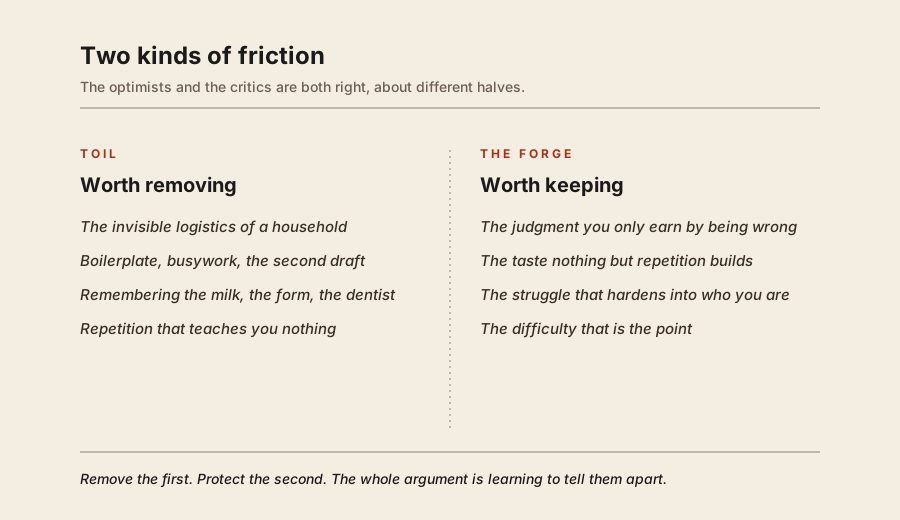
The trouble is that the two look the same from outside. Both show up as time, as cost, as a step no one has automated yet. I work on measuring systems like these, and the measurement can’t tell them apart. It catches toil easily. It has no way to see the friction that was making someone better, so it counts that friction as waste, cuts it, and calls the cut progress.
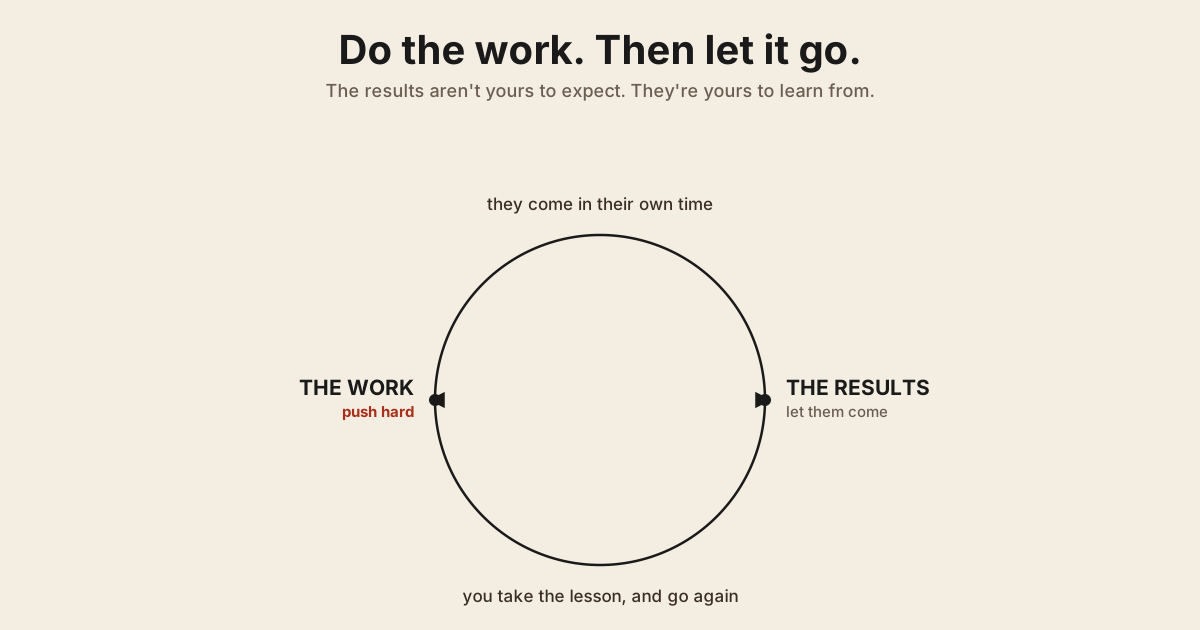
I’ve used one rule for as long as I can remember, since long before any of this: be impatient with your inputs and patient with your results. Inputs are the part you control: the work you actually put in, the question you took the trouble to get right. Results are whatever the world does with that, on a clock you don’t set. Aimed at your inputs, impatience is just focus. Aimed at your results, it curdles into anxiety, and nothing arrives a minute sooner for it. Most of the misery I’ve watched people make for themselves is impatience pointed at the wrong half.
Frictionless AI sells the opposite habit. It hands you the result now and tells you the inputs are the machine’s job. That is the rule backward. The odd thing is that when I use these tools well, I do the reverse of what the pitch describes. I get more careful with the inputs, not less, because the tool took the busywork and gave me back the work that needs judgment.
Too little friction and you go slack. Too much and you break. Whoever you’re trying to become turns up somewhere between them. “Frictionless” is a sales word for one extreme, sold to you as freedom.
I know this from GiveTide. “Acquired in 2022” is the line that fits on a résumé. It leaves out the five years of building the company before there was any result worth writing down—the long part the acquisition later compressed into one line. Honeydew now lets me build faster, but speed is useful only when it clears away setup and repetition. I still need the part where I decide what is worth building and live with being wrong.
I’d change one thing about the pitch. Stop promising people the machine will take the hard part off their hands. It can’t, really. It can only move the hard somewhere that gives nothing back. Leave them the hard part. It was the part that made them.
—Pete
Share this article
Continue the thread
Related reading
Essay
If a Data Center Comes to Town, Your Electric Bill Should Go Down
Data centers should pay their grid costs through bankable large-load tariffs and fund a separate, project-sized dividend for the households that host them.
Read next
Essay
Monsters of the Mind
We taught a generation to mistake disruption to the jobs they wanted for the disappearance of work itself. The map is changing—and the technology redrawing it may also help us learn the next route.
Read next
Essay
Falls the Shadow
In 2016 the godfather of AI said to stop training radiologists. A decade later their pay had climbed and employers reported shortages. This essay asks whether the same forecast error is now being made about writing—through the two halves of every job, the vagueness spiral, and a falsifiable bet on the English major.
Read next